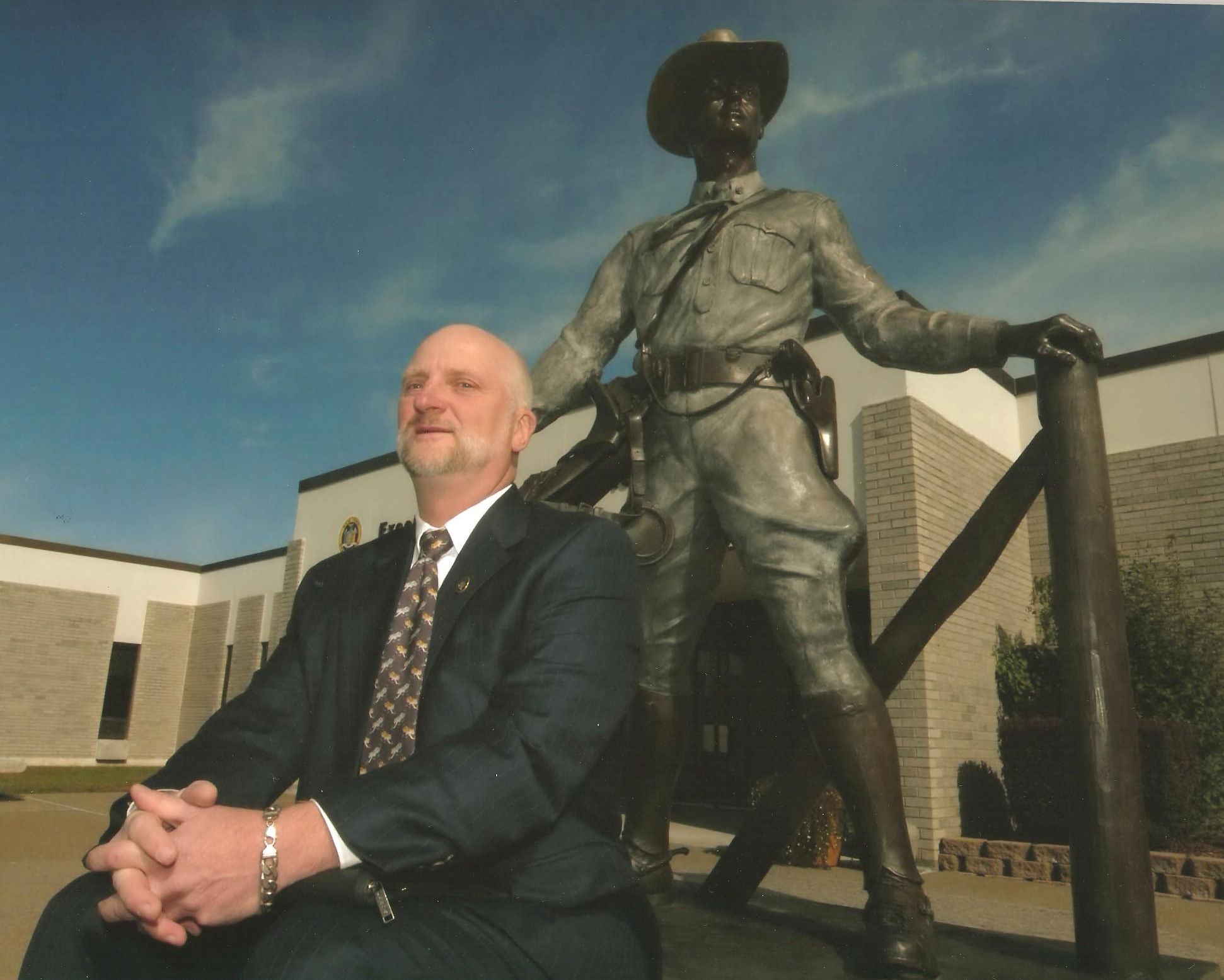
Terry O'Neill is an Albany, New York-based public affairs consultant and
freelance writer who focuses on public safety issues. He is the son of a Connecticut State Trooper, the grandnephew of Irish
immigrants who served municipal police agencies in Connecticut and the great-grandson of Constable William Stephens of Stradbally,
County Waterford, who retired from the Royal Irish Constabulary in 1903.
Mr. O'Neill is a graduate of Marianapolis Preparatory School of Thompson, Connecticut, where he concentrated
on Classical Studies. He studied Western Civilization at Providence College, earned a Bachelor's degree in English Literature
from the University of Connecticut and read Law at Albany Law School.
Mr.
O'Neill is a Vietnam Era veteran of the U.S. Navy and takes pride in a family tradition of voluntary US military service
that began with his grandfather Daniel O'Neill, a WW I veteran of the 69th New York Regiment -- the Fighting Irish -- his
father Joseph (USN) and two uncles James (US Army Air Corps) and Daniel (USA) who served with great distinction in World
War II. James, a crack aircraft mechanic, kept sixty warplanes flying over Nazi forces and after the war kept
planes flying in a historic airlift of Jewish refugees to Palestine.
In
over twenty-five years in public affairs in Albany, Mr. O'Neill has specialized in the legislative process and in issues
affecting public safety, drug policy, crime prevention, community policing, restorative justice, judicial reform and
law enforcement administration. His involvement in a number of major police organizations and in campaigns for legislative
initiatives targeting organized crime, drug trafficking and community crime prevention have enabled him to develop a far-flung
network of contacts in law enforcement and academia. Legislative initiatives undertaken by Mr. O'Neill beginning in
1992 have cumulatively generated over $100 million in investment to the benefit of the state and people of New York.
Mr. O'Neill's career in public affairs began when
he became Counsel to New York State Assembly Assistant Speaker Edward Griffith in January 1984 Mr. Griffith, a native
of Panama, represented the distressed and neglected 40th Assembly District comprised mostly of the East New York section of
Brooklyn. The experience gave Mr. O'Neill valuable insight into the needs and concerns of the people of New York's inner
cities. He was especially impressed by the powerful and positive role played by the religious leaders of small congregations
in such communities.
In 1986, Mr. O'Neill joined
the New York State Division of Criminal Justice Services as a legal advisor to the state's municipal police executives on
matters relating to human and civil rights. From
1988 through 1994, he was frequently consulted by the Governor’s office on law enforcement and crime prevention issues.
He was involved in drafting and negotiating major legislative enactments improving police administration and enhancing the
statutory framework for waging the war on drugs and violent crime. In all the years since his first introduction to
New York's law enforcement community, Mr. O'Neill has been an advocate for the most progressive and community-oriented innovations
in public safety, including community policing, alternative sentencing and restorative justice. In 2011, the Buffalo
Common Council appointed him to a commission to consider reorganization of the police department serving the state's second
largest city and turning it into a neighborhood policing agency.
Mr.
O'Neill's work and his interest in promoting community justice also took him into the field. In 1990-92, he represented the
State Director of Criminal Justice in responding to communal violence that had broken out on the St. Regis Mohawk Indian Reservation.
With a Canadian colleague, Mr. O'Neill organized a task force of New York, US, Canadian and Mohawk police and native
affairs agencies serving the reservation to work toward the creation of an indigenous comminty police service for the Mohawk Nation. At
the same time, he served on a state negotiating team that led to state/tribal casino gaming compacts that have brought unprecedented
prosperity to the Oneida and Mohawk Indian Nations.
Throughout
the 1990s, Mr. O'Neill traveled the nation with Tom Constantine and the New York State Association of Chiefs of Police conferencing
with colleagues from around the world under the auspices of the International Association of Chiefs of Police. These
travels exposed him to cutting-edge public safety strategies and programs. In 1993, Mr. O'Neill introduced Triad, an
IACP-sponsored program of enhanced police service to the elderly, to New York. He also drafted legislation, signed
into law in 1998, that has begun the process of developing a police specialty known as Elder Service Officers.
Mr. O'Neill has, over the years, served pro bono as Counsel to a variety of
community service nonprofits including the Mid-Hudson Crime Prevention Association, the Capital District Coalition for Crime
Victims' Rights, the Russian-American Kids’ Circus, Lydia's House, Inc., House of Forgiveness, Inc. and Millenium
Reign, a faith-based organization that educates inner-city young people about the dangers of HIV/AIDS. In April 2012,
Mr. O'Neill was recognized for years of pro bono service to crime victims's advocates by being awarded "The Unsung Hero
Award" by the New York Crime Victims' Assistance Task Force.
Mr.
O'Neill is an advocate for children and in 1990 worked on legislation creating a training program for police Juvenile Officers.
In 1994 he suggested legislation that created a fund to enhance public education and prevention programs to combat child abduction
and exploitation. Subsequent amendments to that law have resulted in a revenue stream of $300,000 a year for this fund. In
recent years, Mr. O'Neill's interest in Swedish language, literature and culture has led to a relationship with Mentor International,
an international youth anti-drug abuse program founded by Her Majesty Queen Silvia of Sweden in 1994.
In 1999, Mr. O'Neill helped Doug and Mary Lyall, parents of Suzanne Lyall, a
State University of New York student who disappeared in March 1998, win passage and enactment of the College Campus Security
Act which creates a framework for cooperative investigation of serious crimes reported on college campuses between campus
security and local law enforcement agencies.
Also in 1999, Mr. O'Neill teamed up with John Myers
of Saratoga Springs to begin what turned out to be a more than decade long effort to enact the Dignity for All Students Act
(DASA), landmark school anti-bullying legislation that took full effect in July 2012. The campaign to enact this legislation
ultimately brought together a coalition of some two hundred organizations representing students, parents, teachers, school
administrators and advocates for children.
As the son of a State
Trooper, Mr. O'Neill prides himself on being, as former State Police Superintendent Tom Constantine has put it: "A loyal
and good friend to the State Police." He was responsible for legislation authorizing a payroll deduction option
for members and employees of the New York State Police to support the work of the Trooper Foundation -- State of New York,
Inc. adding more than $100,000 a year to fund a disaster relief program for State Police families. (Chapter 613, Laws
of 1998)
Mr. O'Neill also joined a group of
retired Troopers in the 1993 campaign to create a privately-funded monument -- the Gray Rider -- to members of the New York
State Police. In 1998, he helped retired and disabled New York State Trooper Paul A. Richter get a law enacted that has since
raised more than $70 million to fund research to find a cure for spinal cord injury paralysis. Mr. Richter had
been feloniously shot and paralyzed on the job in 1973. All of these monies have been awarded in the form of research
grants to medical research facilities in New York with the effect that the state is today a national leader at the cutting
edge of advanced neurological research.
Mr. O'Neill
has long been writing verses and stories celebrating members of New York's law enforcement community and chronicling their
heroic struggle against violence and intolerance. His work has appeared in police publications and on web sites throughout
the country and overseas. He is the author of a book of children's verses with a message of respect for law and law enforcement
officers called Constantine's Circus.
Mr. O'Neill is a prolific composer of music for the Highland bagpipe. His signature tune "Thomas A. Constantine"
was published in the British Isles in 1996 by the Irish Pipe Band Association. Four years later, Tom Constantine
was asked to play a leading role in ending over three decades of terrorist violence in Northern Ireland.
In recent years, Mr. O'Neill ventured into the academic world, having had the
privilege of being associated with the Distance Learning Center of Empire State College, a subsidiary of the State University
of New York, that serves many criminal justice professionals who are not able to attend full-time colleges. He developed and
taught a variety of basic criminal justice and social studies courses. He has also served as a substitute teacher in
the Albany School District interacting on a daily basis with the children of the city of Albany.
In November 2007, Mr. O'Neill declared himself an independent candidate
for election to represent New York's 104th Assembly District. He was nominated as the candidate of the Republican
Party. Endorsed by the bipartisan reform group Responsible New York, he joined civic-minded fellow New Yorkers
who share his commitment to responsible budgeting, real estate tax reform, campaign finance reform, government transparency
and equitable distribution of economic development resources. He scored an impressive 21% of the vote against a long
time incumbent in an overwhelmingly Democratic district.
In
July 2009, Mr. O'Neill began his second foray in electoral politics running as a Republican for Albany's Common Council representing
the downtown 6th Ward. The 6th Ward abuts upon the Albany Medical College, which has received several generous research
grants from the Spinal Cord Injury Research Grant Program, and the Rockefeller College Scool of Public Affairs and Policy
where Tom Constantine has been a faculty member since his 1999 retirement.
In campaigning for municipal office, Mr. O'Neill pledged to bring to his constituents a public
safety strategy that represents a synthesis of progressive community, problem-solving and intelligence-led policing, community
crime prevention and a fundamentally victim responsive philosophy. He also intends to work with local institutions of
higher learning and research to generate a lively conference and convention business focusing on public security, transnational
organized crime and advanced neurological research..
Mr.
O'Neill remains pledged to work toward long overdue court reform, a new policy for controlling drugs of abuse, thoroughgoing
reform of our state’s correctional system with emphasis on the reintegration of the tens of thousands of ex-offenders
who return to our communities every year, advanced medical research focusing on the central nervous system and the renewed
assertion of New York‘s pioneering tradition of leadership in exposing, confronting and defeating organized crime and
terrorism.
His vision for the economic future
of the Capital District is founded upon advancing the prestige of the institutions of research and higher learning for
which the Capital District is renowned. He also has a special commitment for the well-being of our military veterans
and their families, many of whom have been affected by injuries sustained in their service in our current overseas conflicts.
As the signature casualty of the current conflicts is traumatic brain injury, the result of the enemy's weapon of choice,
the roadside bomb, O'Neill pledges to build upon the success of the Spinal Cord Injury Research Board Act of 1998 by making
New York a leader in medical research on the central nervous system.
At this time, Mr. O'Neill
has devoted his energies and resources to supporting and maintaining all of the programs and initiatives with which he has
been associated since he began his career withe the New York State Legislature in January 1984. That institution has
been castigated by many as "the most dysfunctional in the nation." Mr. O'Neill does not believe that for a
moment. He has seen too many positive things accomplished by that body over the past twenty-nine years to go along with
that.